|
Key Takeaways: — Chronic lower back pain lasting six months or longer rarely resolves by repeating the same treatments that didn't work the first three times. — The spine is almost never the real driver. Your lumbar segments are downstream of a mechanical system — hip flexors, deep stabilizers, pelvic floor, surrounding fascia — that most providers never assess directly. — Standard imaging doesn't catch adhesion. That's why so many patients get a disc diagnosis, have the disc treated, and still hurt. — Resolve Soft Tissue & Spine in SouthPark Charlotte uses Adhesion Release Methods (ARM) to find and release the specific soft tissue restriction loading your spine, then sequences stability and strength work on top of a corrected foundation. — Most chronic back pain patients see meaningful change within 8-12 visits whether their pain has lasted 6 months or 15 years. |
Your back has hurt for months. Maybe years. You've seen a chiropractor — maybe two. You've done physical therapy at least once. You've had the MRI, and someone pointed at a disc and said "that's probably it," or someone said "the scan looks fine," and you walked out of that appointment feeling worse than when you walked in because now you don't even have an answer. You've tried stretching. You've tried strengthening. Maybe you've had injections, and they worked for a while and then stopped. Maybe you've been offered surgery. Maybe you've already had it.
And here you are. Still looking.
At Resolve Soft Tissue & Spine in Charlotte, almost every chronic lower back pain patient we see has been through two, three, four providers before they find us. The treatments change. The frustration doesn't. And the one thing almost nobody has explained — because almost nobody is looking at it — is why standard chronic back pain care so consistently misses the actual mechanical driver of your pain.
This isn't the article that tells you to do more of what hasn't worked. This is the one that explains what the standard playbook keeps missing, and what a different approach looks like.
Think of Your Spine Like the Last Domino in a Long Line
Picture a row of dominoes. The last one in the line falls. That's your lumbar spine. That's where the pain shows up. That's where the MRI gets pointed, where the adjustment gets made, where the injection goes, where the surgery operates.
But the last domino didn't fall by itself. Every domino before it fell first — in a specific order, with a specific force. If you want to stop the last domino from falling again, you don't fix the last domino. You figure out what started the chain and interrupt it there.
Your lumbar spine sits at the end of a mechanical chain. Hip flexors in front. Glutes and hamstrings behind. Obliques and transverse abdominis around the sides. Pelvic floor below. Diaphragm above. Fascia connecting all of it. When any of these pieces is restricted, the load has to go somewhere. The spine ends up as the symptom site because it's the structure asked to absorb what the rest of the system can't.
Fix the last domino and the chain reactivates the next time you bend, lift, sit for too long, or sleep wrong. That's why standard chronic back pain treatment so often works for a while and then stops working. The treatment addressed the last domino. The chain is still falling.
The Four Dominos Standard Care Keeps Missing
In almost every chronic lower back pain case we see at Resolve, there are four tissue regions involved — and all four are usually under-addressed or ignored in standard care.
1. The hip flexors — and the real question nobody asks: why are they tight?
You've probably heard about the psoas. Everyone talks about it. Patients get stretched, massaged, needled, foam-rolled. Nobody asks why the muscle is tight in the first place.
Here's what almost nobody addresses: there's a nerve that runs directly through the psoas called the femoral nerve. Think of it as the sciatic nerve of the front of your body. The sciatic nerve runs down the back of your leg and gets a huge amount of clinical attention — books, podcasts, specialists, injections, surgeries built around it. The femoral nerve runs down the front, through the psoas and the deep hip flexors, and almost no one talks about it.
When adhesion forms around or within the psoas and the surrounding deep abdominal structures, the femoral nerve gets entrapped. The muscle tightens up as a protective response — your body isn't being stubborn, it's guarding an irritated nerve. You can stretch that psoas every day for a year. The nerve is still being irritated. The muscle will tighten right back up the moment you stop stretching, because the actual driver was never addressed.
Add in the lateral femoral cutaneous nerve (which can cause a burning or numb patch on the outer thigh) and the obturator nerve (deep in the pelvis), and you have three major anterior nerves that can be driving hip flexor dysfunction and anterior hip pain. Standard care doesn't assess any of them. Direct manual work does.
The patient looks like this: 45-year-old desk worker. Back and front-of-hip tightness started in their late 30s. Worse in the morning and after sitting for long stretches. Says their back feels "locked up" when they stand from a chair. Has stretched hip flexors religiously for years. Maybe gets temporary relief. Nothing has held — because the stretch isn't releasing the adhesion that's entrapping the nerve that's driving the tightness.
2. The core — but as a circumferential system, not a single muscle
Standard core advice treats the core like it's one or two muscles. Transverse abdominis. Multifidus. "The deep core." As if you can isolate them and strengthen them one at a time.
That's not how your core actually works. Your core is a circumferential system — rectus abdominis in the front, obliques on the sides, transverse abdominis wrapping all the way around, multifidus running up the back along the spine, pelvic floor at the bottom, diaphragm at the top. It all engages together. Treat one piece in isolation and you miss the system that was built to work as a unit.
Then there are the oblique slings — the diagonal lines of muscle and connective tissue that transfer force across your body from one shoulder to the opposite hip. These slings are what let you walk, rotate, throw, swing a golf club, pick up a toddler without hurting your back. When one piece of a sling is restricted, the whole force-transfer chain breaks down. The spine ends up absorbing what the sling couldn't carry.
At Resolve we think about the core as a canister — a full 360-degree system that engages top, bottom, front, back, and both sides simultaneously. Chin tucked. Ribs down. Pelvic floor engaged. Glutes slightly on. Breath staying neutral. We teach the canister position first because every piece of strength and stability work we assign later gets built on top of it. If the canister breaks during a rep, the rep is over. The core finally working as one coordinated unit — not as a stack of isolated muscles — is where durable change comes from.
The patient looks like this: former athlete, now late 40s. Can hold a plank for two minutes. Has done every core routine on the internet. Still has daily back pain. Has been told repeatedly their core isn't strong enough. The strength isn't the problem. The coordination of the circumferential system is. The pieces aren't firing together.
3. The pelvic floor
The pelvic floor is the bottom of the core canister. It co-contracts with the deep abdominals and the diaphragm to generate the intra-abdominal pressure that protects your spine during loading. When the pelvic floor is restricted — common after pregnancy, after any pelvic surgery, after years of sedentary work — the trunk loses its ability to generate that pressure. The spine compensates by over-recruiting superficial muscles and leaning on bony structures for stability.
The patient looks like this: mother of two in her 40s. Youngest kid is now in school. Her back pain started during her first pregnancy and never fully went away. Pelvic floor PT helped a little. Still has days where sitting is miserable and standing from the floor requires a strategy.
Standard back pain care almost never assesses the pelvic floor outside of recent postpartum. In reality, pelvic floor dysfunction is a hidden driver of chronic back pain in a much broader population than most providers realize.
4. The fascial connections (how the pieces talk to each other)
Fascia is the connective tissue that connects every muscle and transfers force across your body. We don't treat it as its own standalone project — we treat it as part of the system that transfers force from the hip to the trunk to the shoulder and back down. When fascia is restricted, the forces that should disperse across your pelvis and trunk end up concentrated at the lumbar spine. If we find a fascial restriction that's affecting function, we address it where it's doing the damage. We don't go on a fascial scavenger hunt.
Why PT, Chiropractic, Injections, and Surgery Keep Falling Short
Each of these treatments has a legitimate purpose and real patients it helps. Many of our patients benefited from one or more of them at some point. We're not here to disparage any provider. What we want to explain honestly is the pattern of why these treatments so often fail to resolve chronic cases — because that pattern tells you exactly what's missing.
Physical therapy
Standard PT for chronic lower back pain focuses on strengthening, mobility drills, and movement retraining. These are valuable when the tissue can respond to them. If adhesion is restricting how your deep stabilizers or hip flexors glide, strengthening them just loads a stuck system. The exercises feel productive. The restriction stays. The patient hits a plateau or backslides the moment the exercises stop.
Chiropractic care
Adjustments restore joint motion to lumbar segments that have become restricted. Relief is often immediate. But adjustments don't change the soft tissue load that caused the joint to lose motion in the first place. The joint moves, the surrounding tissue stays restricted, and the compressive load returns. This is why patients so often describe chiropractic as "helpful but I need to keep going back." The system reloads the joint between visits.
Cortisone and other injections
Injections quiet local inflammation. Relief can last weeks to months. But injections don't change the mechanical loading pattern that caused the inflammation. When the medication wears off, the mechanical stress is unchanged and the inflammation returns. The pattern of "it worked for three months each time, now it only works for one" is extremely common in long-term chronic back pain patients. Repeat corticosteroid use also has its own tissue-weakening effects over time.
Back surgery
Surgery decompresses, fuses, or replaces specific structural elements of the spine. For true structural problems with clear surgical indications — progressive neurological deficit, severe stenosis with cauda equina symptoms, grossly unstable segments — surgery is often the right call.
For chronic back pain cases where the structural finding is ambiguous, surgery addresses one location but leaves the mechanical system that overloaded that location in place. This is one reason "failed back surgery syndrome" is a recognized clinical pattern. The structural goal was accomplished. The pain is still there because the chain that caused the problem is still falling. Our full piece on chronic pain after multiple failed treatments addresses this patient population in depth.
What a Resolve Visit Actually Looks Like
The first visit is a 30-minute consultation. Seated conversation. No table work on this visit. We take a detailed history of your pain — when it started, what you've tried, what helped, what didn't, where you feel it, what makes it worse. We review any imaging you have. We ask the specific questions that help us figure out which of the four tissue regions is most likely driving your case.
Then we tell you honestly whether we think your pain is something we can help with. If adhesion looks like a primary driver based on your history and symptoms, we recommend moving to a full exam. If it doesn't — if you need a different kind of care — we tell you that and we point you toward the right next step. We don't take on cases where we don't think we'd produce the outcome you deserve.
The second visit is a 60-minute exam and first treatment. We do specific movement tests, hands-on palpation, and sort every finding into a category: mobility problem, stability problem, mechanical loading problem, motor control problem, or capacity problem. The sorting determines what we treat first and in what order.
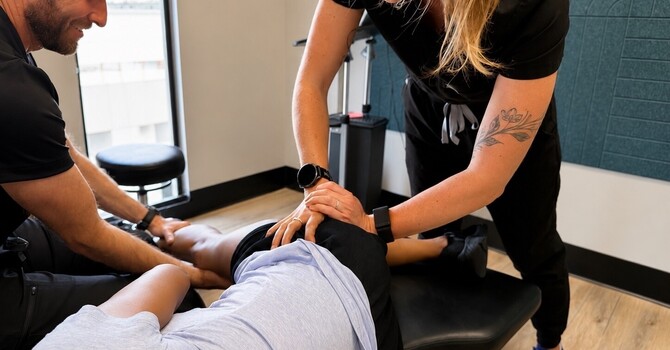
Then we treat. We work on the highest-priority tissue, retest the movement we found restricted, and show you the change in the room before you leave. If the test improved, we build on it next visit. If it didn't, we change direction.
If we're not seeing measurable change in your movement tests within the first several visits, we tell you. We either change our approach entirely or we honestly reassess whether this is the right path for your case. We don't continue care that isn't producing results. That's not standard in chronic pain care. It should be.
How Chronic Back Pain Actually Resolves (It's Not Linear)
Patients expect chronic pain recovery to look like acute injury recovery. It doesn't. Acute injury recovery is a straight line — you tweak your back lifting something, it's bad for a week, better the next, mostly gone in a month. Chronic pain recovery is a zigzag. Symptoms improve, plateau, briefly regress, then improve again as deeper tissue starts changing.
Here's the typical arc for a chronic lower back pain case at Resolve:
Visits 1-3: The consultation, the exam, and the first few treatments. Movement tests start showing change. You may or may not feel symptoms change yet, but the testing shows the tissue is responding.
Visits 4-8: Symptom change usually becomes meaningful. Sitting tolerance improves. Morning stiffness decreases. Specific movements that were painful — bending, twisting, standing from a chair — become less painful. The adhesion work in hip flexors, deep stabilizers, and pelvic floor is driving the change.
Visits 9-14: Corrective exercise comes in alongside the ongoing manual work. We sequence stability work and strength work on top of a corrected foundation. Durability starts building. Changes made in the treatment room start lasting outside of it.
Visits 15+: For complex cases, post-surgical cases, or very long-standing cases, more visits may be needed. For straightforward cases, maintenance begins — about one visit per month to prevent adhesion from rebuilding.
Most chronic lower back pain patients see meaningful change within 8-12 visits. Complex cases run 12-20.
What Actually Changes When It's Working
Patients often ask what success looks like. For chronic lower back pain, the markers show up in a specific order:
-
Movement tests improve first. Straight leg raise comes up further. Lumbar flexion increases. Hip ranges open up. These happen in the first 2-4 visits and are the leading indicator the underlying restriction is changing.
-
Morning stiffness decreases next. The time it takes to feel loose after getting out of bed shortens from an hour down to minutes.
-
Sitting tolerance returns. The patient who could sit for 20 minutes before pain forced them up can sit for an hour, then two, then a full workday.
-
Activity tolerance returns. The specific activities that were taken away — walking the dog, carrying groceries, playing with your kids, lifting at the gym, sitting through a flight — come back one at a time.
-
You stop thinking about your back. This is the real marker. The chronic back pain patient's inner monologue is dominated by their back. When you realize you went a whole day without thinking about it, that's resolution.
Common Questions About Chronic Lower Back Pain
I've had this for over 10 years. Is it too late?
No. The length of time you've had pain doesn't predict how well you'll respond to the right treatment. Some of our best resolutions have been patients with 15 or 20 years of chronic back pain. What matters is whether adhesion is a primary driver of your case — not how long you've had it. Longstanding cases sometimes need more visits (12-20 instead of 8-12), but the response pattern is often faster than patients expect.
My MRI showed a disc bulge. Is that definitely what's causing my pain?
Maybe. Maybe not. A 2015 study in the American Journal of Neuroradiology found disc bulges in 30-40% of pain-free adults in their forties and over 60% of those in their sixties. Disc findings on imaging are extremely common in people who have no pain at all. The disc may be contributing to your pain, or it may be an incidental finding and the actual driver is adhesion in the surrounding tissue. Our full disc pillar addresses this question in depth.
I've had back surgery and I'm still in pain. Can you still help?
Yes. Post-surgical back pain patients are one of the largest segments of our chronic back pain caseload. The surgery usually accomplished its structural goal. But the mechanical system that was loading the surgical site is still there, and surgery adds its own layer of scar tissue adhesion. Addressing both the pre-existing mechanical drivers and the surgical scar adhesion typically produces significant improvement — sometimes more than the surgery itself produced.
How is this different from physical therapy?
Standard PT strengthens muscles and improves general mobility. ARM identifies and physically releases adhesion in soft tissue. They address different problems. Many of our patients continue with PT after ARM — strengthening and movement retraining work much better once the restrictive adhesion is gone. The two approaches complement each other when sequenced correctly.
How is this different from chiropractic?
Chiropractic adjustments restore joint motion. ARM addresses the soft tissue restriction between, around, and through those joints. Joints can move better after an adjustment while the surrounding adhesion stays unchanged — which is why patients so often describe chiropractic as helpful but needing frequent return visits. Treating the soft tissue drivers directly is what shifts the pattern from recurring to resolved.
Do you give exercises? What's your approach to strength training?
Yes — but sequenced after tissue work, not before. We treat the restriction first, then layer stability and strength work on top of a corrected foundation. We don't hand you a sheet of ten exercises on visit one. We teach one or two targeted movements once your tissue is ready to receive them. Our full answer on exercises and strength training is on our FAQ page.
Do you take insurance?
We do not take insurance. Insurance dictates which codes get reimbursed and limits how much time per visit, neither of which allows the kind of care chronic back pain actually requires. Patients pay directly for results. HSA and FSA cards work.
How many visits will I need?
Most chronic lower back pain cases run 8-12 visits over 2-3 months. Complex cases, post-surgical cases, or very longstanding cases run 12-20. We tell you honestly at each visit whether the tests show you're responding — and if they don't, we change direction or point you to a different kind of care.
What should I expect at the consultation?
A 30-minute seated conversation. No table work on this visit. We take a detailed history, review your previous care, and tell you honestly whether we think your pain is something we can help with. If adhesion is clearly a primary driver, we recommend moving to a full exam. If it's not, we tell you and point you to the right next step.
Does the treatment hurt?
The pressure is intense in the moment but tolerable. Most patients describe it as deep achy pressure during treatment with significant relief afterward. We adjust based on your feedback. Soreness for 24-48 hours after the first few visits is normal.
About Resolve Soft Tissue & Spine
Resolve Soft Tissue & Spine is a cash-pay manual therapy clinic in Charlotte, North Carolina, at 5970 Fairview Rd, Suite 712 in SouthPark. We treat chronic musculoskeletal pain in patients who have not found lasting relief from physical therapy, chiropractic care, injections, or surgery.
Zac Breedlove and Emma Weber are the Charlotte-based providers at Resolve. Both continue to train multiple times a year — attending clinical conferences, mentorships, and specialized trainings in manual therapy and corrective exercise systems. The investment of time and money into ongoing education is deliberate. Chronic pain is a hard problem, and treating it well requires staying current with the research, the methodologies, and the specific skills needed to produce lasting results. When you book with Resolve, you're booking with providers whose practice depends on actually getting people better.
We use Adhesion Release Methods (ARM), a six-step hands-on system that identifies and treats soft tissue adhesion — the dense fibrous scar-like tissue that limits movement, traps nerves, and forces surrounding structures to overload. Adhesion doesn't appear on MRI, which is one reason chronic pain so often goes undiagnosed despite multiple provider visits. We also integrate corrective exercise and strength and stability work, built on top of a corrected tissue foundation, so the changes we make in the treatment room translate into durable change outside of it. For the peer-reviewed research supporting this approach, see our Research page.
Related: our condition page on chronic lower back pain, our pillar on bulging and herniated discs, our pillar on sciatica, and our pillar on chronic pain after multiple failed treatments.
Ready to Figure Out What's Actually Driving Your Back Pain
If your chronic lower back pain has lasted more than three months and hasn't responded to what you've tried, a consultation is the right next step. We'll take a full history, give you an honest read on whether this is something we can help with, and tell you clearly what the path forward looks like — including whether that path is with us or with someone else.
Schedule a consultation at Resolve Soft Tissue & Spine in SouthPark Charlotte. We'll give you a straight answer within the first 30 minutes.

Zac Breedlove
Contact Me