
.jpg)
INTRODUCTION: Why You’re Still in Pain After "Doing Everything"
If you're reading this, chances are you or someone you love is still dealing with pain that just won't go away. Maybe it's your back, shoulder, or hip. You've done physical therapy, chiropractic, massage, injections—heck, maybe even surgery. But the pain keeps coming back.
Here's the truth: most chronic pain isn't caused by what you think. MRIs, X-rays, and even well-meaning therapists often miss the root cause.
And that root cause? For many, it’s adhesion.
What Is Adhesion?
Adhesion is like glue inside your body. It’s scar tissue that forms between muscles, nerves, and joints—sticking them together and restricting healthy movement.
Imagine this:
You’re trying to slide two pieces of paper apart, but someone dripped honey between them. That’s what adhesion does to your tissues. And when tissues can't slide and move freely, they hurt. They wear down. They trap nerves. They cause stiffness, weakness, and pain that doesn’t respond to typical treatments.
Common Symptoms of Adhesion:
-
Tightness that doesn't go away with stretching
-
Pain that returns shortly after massage or adjustments
-
Numbness or tingling (nerve entrapment)
-
Weakness despite strength training
-
"Stuck" feeling in a joint
Why Traditional Treatments Miss Adhesion
Imaging like MRI and X-rays can’t see adhesion. That’s why so many people hear "everything looks normal," even though they’re still in pain.
Strength training won't break adhesion. In fact, it can bury the problem deeper.
Stretching and massage may feel good temporarily, but they don’t target the root cause. Most therapists don’t palpate deep enough or specifically enough to find and remove adhesion.
That’s where Adhesion Release Methods™ (ARM) comes in.
The ARM System: Fixing What Others Miss
ARM is a 6-step system designed to find and fix adhesion—with precision, consistency, and measurable results.
STEP 1: History & Green Lights
We don’t guess. We ask strategic questions to form a working theory of which tissue and what type of overload might be contributing to your pain. Where does it hurt? What makes it better or worse? What’s the quality of the pain?
STEP 2: Exam (PRP)
We test our theory using PRP:
-
Provocation: What movements increase symptoms?
-
Range of Motion: What’s restricted?
-
Palpation: Can we feel adhesion in the right spots?
STEP 3: Critical Thinking (a.k.a. “Duck Hunting”)
We take all the info and ask: Does the problem walk like a duck and quack like a duck? This is about putting the pieces together, not guessing. It's clinical reasoning based on patterns, tests, and tissue behavior.
STEP 4: Pre-Treatment Planning
We choose the right tool (hands, shockwave, etc.) to treat the specific area and tissue type.
STEP 5: Treatment & Real-Time Feedback
We feel adhesion break under our fingers or tools. We measure range again immediately to confirm progress.
STEP 6: Post-Treatment Re-Test
If it worked, you’ll feel it right away. More motion. Less pain. More strength.
The Science of Adhesion (Simplified)
Adhesion forms when your tissues are under too much stress without enough recovery. It could be from overuse (think sitting for hours, repetitive lifting, or training hard) or trauma (surgery, falls, car accidents). Here’s how it happens:
-
Tension builds in soft tissue.
-
Blood flow decreases.
-
Oxygen drops (hypoxia).
-
Your body responds by laying down collagen—a.k.a. adhesion—to protect the area.
But that protection comes at a cost: movement restrictions, nerve entrapment, and pain.
Real-World Adhesion Cases (By Body Region)
Feet & Ankles
-
Plantar fasciitis that keeps coming back? Adhesion around the heel or big toe flexor tendons may be the real issue.
Knees & Hips
-
Anterior hip pain or IT band tightness? Common signs of psoas or adductor adhesion.
-
Post-surgery stiffness? Scar tissue + missed nerve entrapments often linger.
Low Back & Sciatica
-
Limited forward bend? Could be sciatic nerve adhesion in glutes, hamstrings, or tibial branch.
-
“Disc pain” that doesn't show on MRI? Posterior hip capsule or spinal stabilizer adhesion may be the missing piece.
Shoulder & Neck
-
Pain reaching overhead? Could be restricted capsule or suprascapular nerve.
-
“Knots” between shoulder blades? Likely chronic adhesion in thoracic paraspinals or rhomboids.
The Medical Merry-Go-Round
Many patients walk in after years on the medical merry-go-round:
-
Pain starts.
-
They try stretching, heat, and YouTube exercises.
-
PT helps temporarily.
-
Chiro feels good—but pain comes back.
-
Shots or surgery are recommended.
But if adhesion is the root cause, none of these options resolve it fully.
Adhesion isn’t fixed by strengthening something that’s stuck. It must be removed.
ARM vs Traditional Approaches (At a Glance)
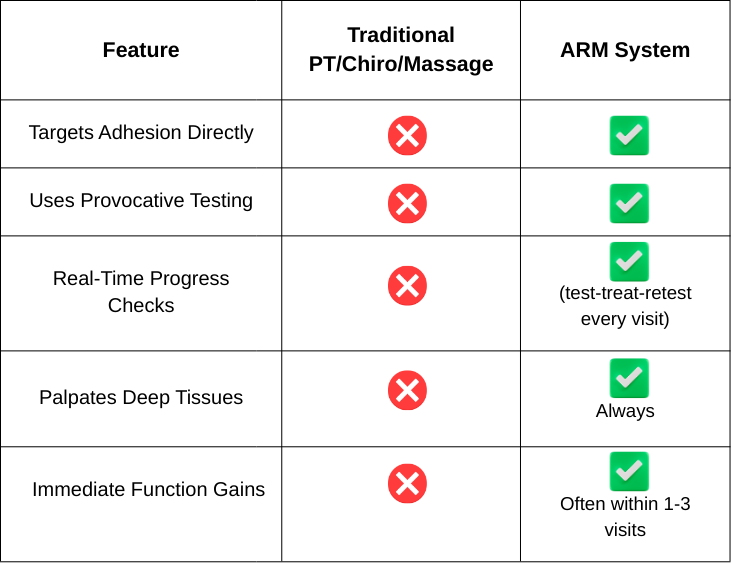
Who ARM Is Not For
-
Patients with 10/10 pain that never changes with movement or load
-
Those seeking general wellness or relaxation care
We focus on mechanical, movement-driven problems with measurable restrictions and solutions.
FAQs: What Patients Want to Know
“Why didn’t my doctor find this?”
Most standard evaluations don’t test for adhesion or palpate soft tissue in detail. If your MRI is clean, you may be told "you’re fine."
“Will it hurt?”
There may be momentary discomfort, but most patients say, "It hurts so good." More importantly, you’ll feel measurable changes after treatment.
“How many visits will I need?”
Most chronic cases require 12 to 16 visits or more depending on the complexity and the layers of tissue involved. Some patients feel a shift within a few visits, but lasting relief requires depth and consistency.
“Does adhesion come back?”
Once removed, adhesion typically stays gone—unless new overuse or injury occurs. We also give you tools to maintain results.
“Is this the same as ART or Graston?”
Nope. ARM uses a systematic 6-step framework that prioritizes diagnosis logic, palpation skill, and immediate retesting. Other methods may be helpful, but they don’t require the same standardization or precision.
How ARM Fits Into Your Healing Plan
ARM isn’t a massage. It’s not general soft tissue work. It’s not a guess.
It’s a system.
At Resolve STS, we combine ARM with education, movement strategy, and strength training built around YOUR body.
When you’re tired of temporary relief and ready to fix the root cause, this is your next step.
Ready to Get Unstuck?
At Resolve Soft Tissue & Spine, we specialize in treating pain that’s been missed by everyone else.
Whether it’s sciatica, shoulder pain, low back pain, or post-surgical stiffness—ARM might be the missing piece.
Book your free consultation today and let’s figure out if we can help you feel better, move better, and get back to your life.

Zac Breedlove
Contact Me
.jpg)
.jpg)
